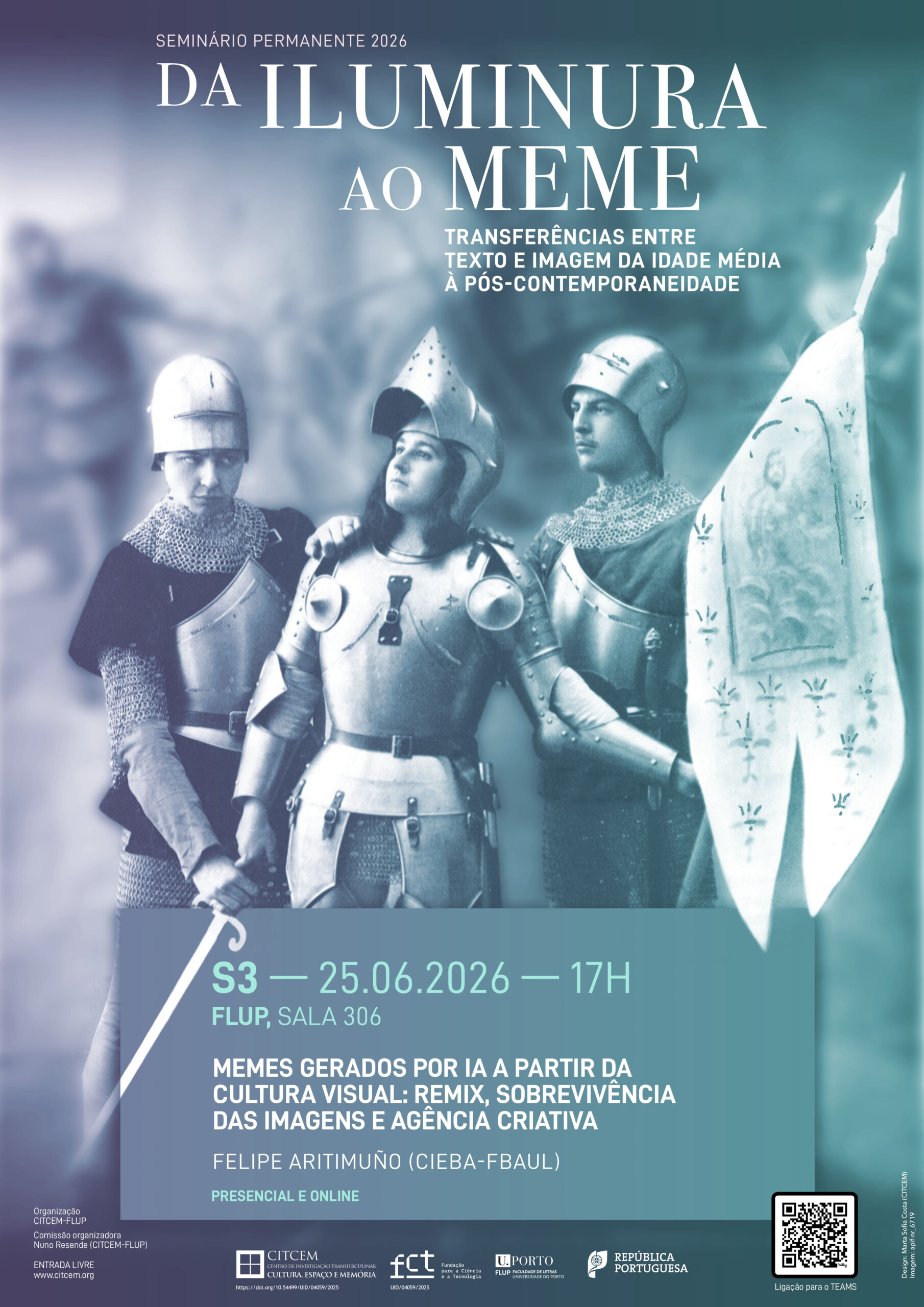
PERMANENT SEMINAR 2026
April-December 2026
SESSION 3
June 25, 2026
AI-generated memes based on visual culture: remix, the survival of images, and creative agency
, and Felipe Aritimuño (CIEBA-FBAUL)
In this paper, we propose to reflect on AI-generated memes within the context of visual culture, understood as a field of analysis of images, their circulation, and the ways in which they produce social, political, and educational meaning. We begin by identifying a symbolic continuity between AI-generated imagery and remix culture, given that generative models expand upon the practices of appropriation, repetition, and displacement found in the music of the 1970s and 1980s, in hip-hop, graffiti, stencils, and, later, digital memes.
Drawing on Georges Didi-Huberman’s interpretation of the survival of images in Aby Warburg, we are interested in exploring how certain visual forms reappear in new contexts, carrying with them memories, conflicts, and narratives that do not unfold in a linear fashion. The surviving image allows us to understand these returns as displaced apparitions, marked by impure temporalities, in which the past continues to exert its influence on the present. Pathosformeln, or “pathos formulas,” help us reflect on the persistence of gestures, expressions, and visual intensities that span different eras and are now recombined by systems capable of producing synthetic characters, scenes, styles, and temporalities.
Today, on Instagram and other platforms, we see artificial influencers traveling through different historical periods, controversial political figures generated by AI, and audiovisual remixes that reinterpret references from popular culture. This content raises important questions regarding visual and historical education, particularly when it can spark interest in the past, but also when it simplifies historical processes, normalizes anachronisms, or reinforces dominant narratives.
The focus is on the modes of representation produced by this content: who speaks through the image, what narratives are constructed or taken for granted, what memories are evoked, what identities are performed, and what possibilities for creative agency remain available to us as both consumers and creators of media content. In dialogue with the E-ARTi project, we seek to explore the possibilities of visual and media empowerment in the age of AI, taking into account media literacy, creative expression, and the production of images with a critical intent, cultural responsibility, and an awareness of their educational implications.
FLUP, Room 306 | 17h00
Link to Teams: https://bit.ly/4sADbDj
Organization: CITCEM-FLUP – Sociabilities and Religious Practices (CITCEM Research Group)
Organizing committee: Nuno Resende (CITCEM-FLUP)