

Events
Local:
Humanities Lab, Piso 0, junto ao Anfiteatro Nobre
Start Date:
10/12/2025
End Date:
10/12/2025
Hours:
Organization:
CITCEM
Investigation Group
People, Markets and Policies
Event type:
Journeys
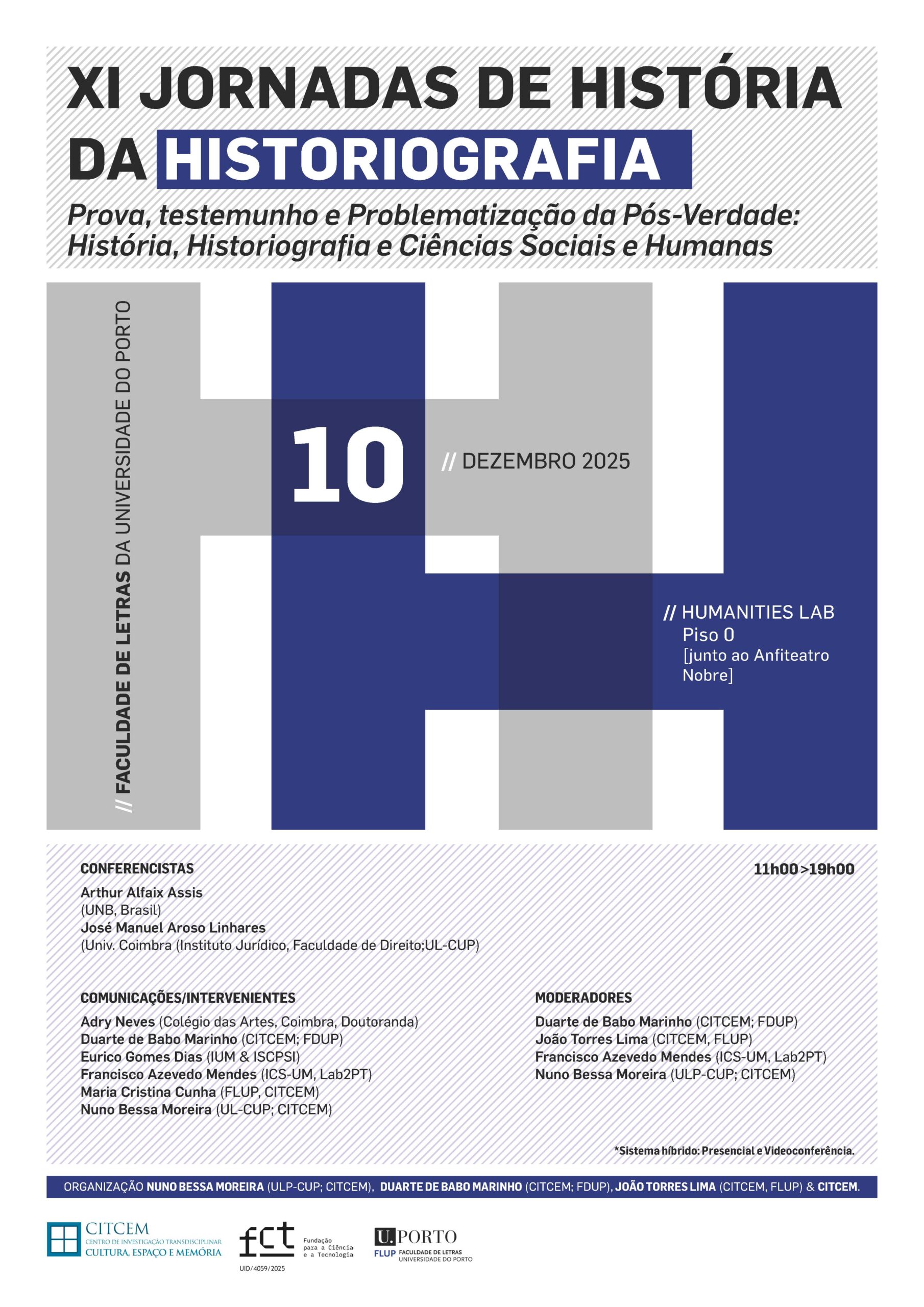
XI Conference on the History of Historiography
XI Conference on the History of Historiography
“Evidence, Testimony and the Problematization of Post-Truth: History, Historiography and Social and Human Sciences.”
Humanities Lab, Floor 0, next to the Noble Amphitheater Porto, December 10, 2025
PROGRAM
10.45 a.m. – Opening by a CITCEM representative.
COMMUNICATIONS
- 11 a.m. – Session 1. Moderator: João Torres Lima.
- “The construction of historical representations in the historiographical exercise”, by Eurico Gomes Dias (IUM & ISCPSI).
- “Some reflections on rigor and proof as epistemic virtues in the historiography of Armando Carvalho Homem”, by Nuno Bessa Moreira (ULP-CUP) and Francisco Azevedo Mendes (ICS-UM, Lab2PT).
- “When the monsters are Us and the Others look at Us between the Historiographical Construction of the Other and the Ontological Possibility of the Fantastic”, by Adry Neves (Colégio das Artes, UC, PhD student)
13:00 – Lunch
15.15 – Session 2. Moderator: Francisco Azevedo Mendes.
- “From Mabillon to Digital Diplomacy: what changes after all?”, by Maria Cristina Cunha (FLUP, CITCEM)
- “Private documents and enforcement action under the Civil Procedure Code. A brief commentary on Constitutional Court ruling no. 408/2015”, by Duarte de Babo Marinho (FDUP, CITCEM)
CLOSING CONFERENCES
16h30 – “Koselleck and the concept of History”, by Arthur Alfaix Assis (UNB)
17:15 – “Evidence in Law as judgment and as narrative: in search of a discourse of practical-prudential truth?”, by José Manuel Aroso Linhares (FDUC, Legal Institute; ULP-CUP)
Presentations: Nuno Bessa Moreira & Duarte de Babo Marinho
Scientific Organization:
- Nuno Bessa Moreira
- Duarte de Babo Marinho
- Eurico Gomes Dias
- João Torres Lima
- Francisco Azevedo Mendes
- CITCEM
__________________________________________________________________________________
DETAILED PROGRAM
10.45 a.m. – Opening by a CITCEM representative.
COMMUNICATIONS
11 a.m. – Session 1. Moderator: João Torres Lima.
“The construction of historical representations in the historiographical exercise”, by Eurico Gomes Dias (IUM & ISCPSI).
Synopsis: Any historiographical work and/or exercise, beyond its ideological, methodological and analytical concerns and reasons, is based on the representations and images conveyed by History itself. With the necessary functional reservations, historians’ work is focused on this problematization, which will make progress, or not, on these reproductions emanating from the association between the truth of the facts and the multiple reasons that make up the construction of history. This cooperation will undergo multiple transmutations, for countless reasons. If we look at the historiographical panorama of more recent times, we quickly realize that little or nothing of what would have been common practice in the news discourse of the 17th-19th centuries, for example, would be applicable today. History continues to provide the necessary foundations for the construction of the most diverse discursive representations with which the accounts of events have been illustrated. These tasks are for historians to analyze, always in search of historical truth and probity, missions that are ever more pressing in these post-truth times.
Curriculum Summary: Assistant Professor with Aggregation at IUM – Instituto Universitário Militar and ISCPSI – Instituto Superior de Ciências Policiais e Segurança Interna, and Integrated Researcher at ICPOL – Centro de Investigação deste Instituto. Corresponding Academician of the Portuguese Academy of History. Corresponding Member of the Scientific Council of the Portuguese Commission of Military History.
“Some reflections on rigor and proof as epistemic virtues in the historiography of Armando Carvalho Homem”, by Nuno Bessa Moreira (ULP-CUP) and Francisco Azevedo Mendes (ICS-UM, Lab2PT).
Synopsis: The aim of this communication is to demonstrate that proof is a key historiographical concept in Armando Carvalho Homem’s historiography, and that it is of undeniable importance at the theoretical, epistemological and methodological levels. In this sense, rigor is an indisputable epistemic and deontological virtue. This communication is divided into two parts. The first discusses the concept of epistemic virtue, along the lines of Herman Paul and João Munhoz Ohara. In the second section, we analyze the theme in question in some of Carvalho Homem’s works, especially in his Aggregation report, in order to assess his relationship with the French methodical school and his belonging to a New Political History.
Nuno Bessa Moreira graduated in History from the Faculty of Letters of the University of Porto in 1999. He completed his master’s degree in Modern History, with a thesis on Cardinal D. Henrique (1539-1578), in 2004. In February 2013 he took public examinations for his doctorate in History, under the guidance of Professor Armando Luís de Carvalho Homem, incident on the Revista de História (1912/1928), a periodical directed by Fidelino de Figueiredo. He completed, in 2016, the National Defense Course, having defended his final research paper in public examinations.
Francisco Azevedo Mendes is an Assistant Professor in the History Department of the Institute of Social Sciences at the University of Minho. Integrated researcher at Lab2/PT. PhD in Theory and Methods. He has developed studies in the fields of History Theory and Contemporary History.
“When the monsters are Us and the Others look at Us between the Historiographical Construction of the Other and the Ontological Possibility of the Fantastic”by Adry Neves (College of Arts, UC, PhD student).
Synopsis: Historiography has a long tradition of producing monsters. Over time, different societies have created monstrous figures as devices for organizing fear, defining identity and legitimizing violence. These historiographical monsters reveal more about the mechanisms of power that produce them than about the creatures themselves: they are projections of human anxiety about the unknown. In the contemporary context of post-truth, this logic is intensifying. The “monsters” of our society are proliferating, manipulative discourses, polarized narratives, disinformation systems that operate as entities that devour public trust. The current epistemological crisis exposes the fragility of our tools for distinguishing proof, testimony and belief. But this communication proposes another gesture. What if the monster wasn’t just a cultural invention? What if the monster could be thought of as an ontological possibility, as a form of life, a presence or entity that exists beyond the human gaze, not necessarily a representation of danger? Drawing inspiration from non-Western cosmologies, contemporary artistic practices and performative perspectives, I propose a rehabilitation of the monster as something more than a simple puppet used to propagate fear. Along the way, I question who decides what is real, how historical evidence is produced and what prevents us from accepting other epistemologies. Perhaps the problem was never the monsters, but our inability to imagine ways of coexisting with what we don’t understand.
Curriculum Summary: PhD student at the College of Arts of the University of Coimbra, degree in Dramatic Arts – Actor Training from the Lusófona University of Porto and a master’s degree in Fine and Intermediate Arts from the FBAUP, with a mark of 20 in the public examinations.
13H00 – Lunch.
15H15 – Session 2. Moderator: Francisco Azevedo Mendes.
“From Mabillon to Digital Diplomacy: what changes after all?”by Maria Cristina Cunha (FLUP, CITCEM).
Synopsis: “Diplomacy is the science of Diplomas”. This statement, apart from being reductive, does not clarify the scope that the analysis of documents per se can bring to historical knowledge. Undoubtedly, the subject of the discipline remains the same as that which led Mabillon to analyze the Merovingian documentation. But far from being a science stuck in time, bound by the basic rules imposed in the 17th century by that monk, Diplomatics has been broadening the object of its study, accepting openness to new themes, new eras and new geographies. At a time when digital is imposing itself on traditional research techniques, we intend to reflect on the career of diplomats throughout the ages and what the work of a diplomatist is at the end of the first quarter of the century. XXI.
Curriculum Summary: She holds a PhD in Medieval History from the Faculty of Letters of the University of Porto (1999), is currently an Associate Professor with Aggregation at that institution, an integrated researcher at the CITCEM R&D Unit (Transdisciplinary Research Center “Culture, Space, Memory”), Vice President of the Comission International de Diplomatique, a member of the Portuguese Academy of History and a member of the Portuguese Society of Medieval Studies (SPEM). She was the Scientific Coordinator of CITCEM between November 2011 and May 2017, and responsible for the Strategic Project (funded by the COMPETE Program) from 2013 to May 2017. He was Co-IP of the project “The reconstruction of monastic archives in Northern Portugal from the Middle Ages to the XIXth century” (EXPL/HAR-HIS/0535/2021) between January 2022 and June 2023. She has participated as a researcher in various national and international projects. His teaching activity has essentially focused on courses in Palaeography and Diplomatics, as well as Medieval Portuguese History. He has supervised several dissertations and theses (master’s and doctoral) on the themes of Medieval Paleography and Diplomacy and Medieval History of Portugal.
“Private documents and enforcement action in the light of the Code of Civil Procedure. A brief commentary on Constitutional Court ruling no. 408/2015”by Duarte de Babo Marinho (FDUP, CITCEM).
Synopsis: With the enactment of the Code of Civil Procedure (2013), the legislator restricted the executive titles, excluding private documents from the exhaustive list in Article 703. This change, if applied retroactively, would take away the enforceability of titles that were valid under the Code of Civil Procedure (1961). The consequences were obvious: creditors were obliged to bring a declaratory judgment action to prove debts that they considered to be proven. In this context, and under Article 82 of Law 28/82, of November 15, the Constitutional Court was called upon to assess and declare the unconstitutionality, with general binding force, of the rule resulting from Articles 703 of the Code of Civil Procedure (CPC) and 6(3) of Law 41/2013, of June 26.º 41/2013, of June 26, “in the interpretation that article 703 applies to private documents issued prior to the entry into force of the new Code of Civil Procedure and then enforceable by virtue of article 46, paragraph 1, letter c), of the 1961 Code of Civil Procedure”.
This ruling thus debated, without reaching unanimity, the constitutional limits of the retroactivity of procedural law when it interferes with the rules of evidence and the very legal certainty of creditors.
Curriculum overview: PhD in Medieval History (FLUP, 2107), postgraduate degree in International Relations (FLUP, 2019) and law degree (FDUP, 2025). His main areas of research are medieval diplomacy and espionage, 19th century international relations and the history of historiography. He is currently studying for a master’s degree in Legal and Administrative Sciences.
CLOSING CONFERENCES
16h30 – “Koselleck and the concept of History”by Arthur Alfaix Assis (UNB).
Synopsis: centered on the multifaceted work of the German historian Reinhart Koselleck (1923-2006), the presentation will explore the interrelationship between the positive concept of History, partly presupposed, partly articulated by the author, and the conception of History originating in the Enlightenment era, which he investigated with the tools of conceptual History. The aim is to show that Koselleck’s theorizing, despite its strong anti-teleological orientation, avoids taking history as a primarily epistemological, methodological, tropological or representational problem – contrary to what was the most common attitude among Western theorists after the Second World War. In summary, I want to argue that Koselleck’s theory is fundamentally a substantive theory of history; a reflection directed, firstly, at “history” as a space of real life, which only secondarily refers to “history” as a form of knowledge or ex post facto discourse.
Curriculum Summary: Associate Professor of History Theory and Methodology at the University of Brasilia, where he has worked since 2009. He obtained his doctorate from the University of Witten-Herdecke, Germany, and his master’s degree from the University of Brasilia. He also studied at the Federal University of Goiás, the University of Bochum and the University of California, Los Angeles. He has a productivity grant from the National Research and Development Council, Brazil. Founding member of the Brazilian Society of Theory and History of Historiography, of which he was treasurer from 2018 to 2024. He is a member of the International Network for Theory of History, as well as the International Commission for the History and Theory of Historiography.
17H15 – “Evidence in Law as judgment and as narrative: in search of a discourse of practical-prudential truth?” by José Manuel Aroso Linhares (FDUC, Legal Institute; ULP-CUP).by José Manuel Aroso Linhares (FDUC, Legal Institute; ULP-CUP).
Synopsis: This communication sets out to tackle the problem of judging evidence in a legal context in terms of its methodological relevance and intelligibility, starting by recognizing the weight of two distinct understandings (if not traditions) and bringing them back to two polarized identity nuclei. It’s actually a question of contrasting the conceptions of proof (or the corresponding modus operandi of the judge) that Alessandro Giuliani (Il concetto di prova. Contributo alla logica giuridica, 1961) associates with the practical-argumentative and empirical-explanatory traditions (if not with the intellectual virtues of phronesis and episteme) and which he reconstructs precisely under the names concetto classico and concetto moderno di prova. What follows is a specific proposal (or a possible synthesis of it), arguing that there are good reasons, in the name of the autonomy of the practical-cultural project of Law, to support a reinvention of the practical-prudential conception today, albeit now with the resources of narrative rationality and the requirement of a dialectical problem/system intentionality.
Curriculum overview: Full Professor of Philosophy of Law, Legal Theory and Legal Methodology at the Faculty of Law of the University of Coimbra and the Lusófona University of Porto. He is currently President of the Coordinating Council of the Legal Institute (UCILeR – The University of Coimbra Institute for Legal Research) and Vice-President of the Portuguese section of the IVR (ATFD – Portuguese Association for Theory of Law, Philosophy of Law and Social Philosophy). He has explored the theory and methodology of evidence, narrative rationality, the debate between inclusive and excluding positivism, as well as the problems of intercultural dialog and the autonomy of law. He has lectured, participated in colloquia and given seminars in Germany, Austria, Spain, Brazil, East Timor, China, France, Angola, Poland, Hungary, Italy, the United States of America, Sweden, Switzerland, Romania and the United Kingdom. His latest publications include the monograph O binómio casos fáceis/casos difíceis and the category of intelligibility legal system. An indispensable counterpoint on the map of contemporary legal discourse?, Coimbra, Coimbra University Press, 2017; the essays “From Brave New World to Island. Huxley’s tales about the Alternatives to Law?” (in The Idea of Justice in Literature, Springer, 2018) and “Exemplarity as Concreteness, or the Challenge of Institutionalizing a Productive Circle between Past and Present, Old and New” (in New Rhetorics for Contemporary Legal Discourse, Edinburgh University Press, 2020), as well as coordinating three Special Issues of the International Journal for the Semiotics of Law (2020, 2021, 2024) and the collective work Human Dignity and the Autonomy of Law (w/ Manuel Atienza, Springer, 2022).
Facebook
Twitter
LinkedIn